

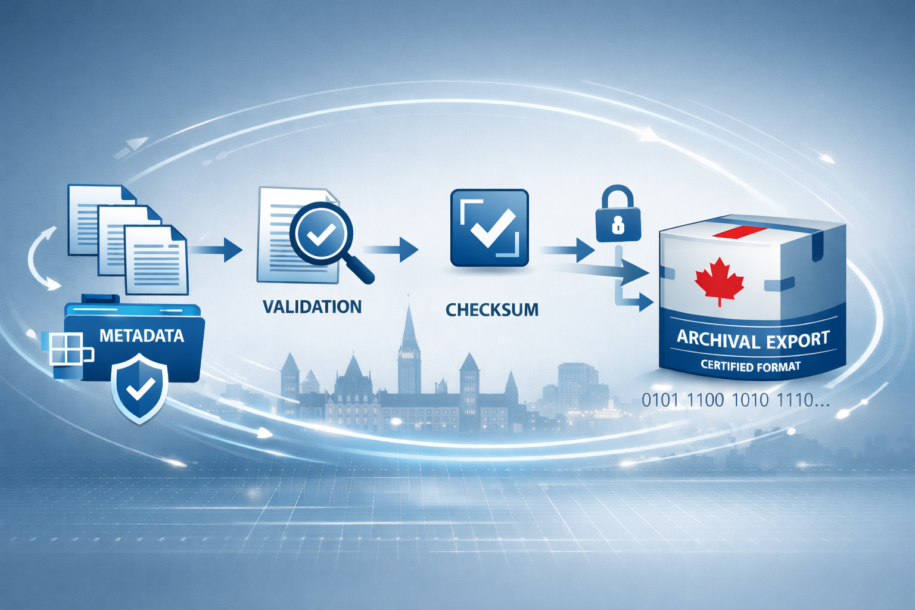
Introduction: The Evolving Landscape of Records Governance
In the Canadian public sector, compliance with Library and Archives Canada (LAC) requirements is not optional; it is foundational. LAC’s Directive on Recordkeeping mandates that government institutions retain, protect, and dispose of records according to approved schedules, ensuring both accountability and historical preservation.
Yet in practice, achieving full compliance often involves complex manual procedures, scattered storage systems, and time-consuming validation.
WorkDynamics’ Archive and Disposition Workflow, fully integrated into ccmEnterprise, simplifies this process, enabling public institutions to meet LAC standards effortlessly while maintaining transparency and control.
Why LAC Compliance Matters
LAC compliance is more than policy, it represents Canada’s commitment to open, transparent governance. Proper archival practices ensure:
- Public accountability: Preservation of records that support decision-making and democratic oversight.
- Operational efficiency: Reduction of storage costs through controlled disposition.
- Legal defensibility: Consistent, documented evidence for audits or access to information requests.
- Cultural preservation: Retention of materials with long-term historical or institutional value.
Failure to comply with this can result in audit risks, data loss, or public trust erosion—issues no government department can afford.
The WorkDynamics Solution: Built for Compliance and Simplicity
A Module Purpose-Built for LAC
The Archive and Disposition Workflow, available in ccmEnterprise v5.4, is designed specifically to support LAC archival and disposition requirements. This utility allows departments to:
- Define export criteria based on retention schedules and record classes.
- Automatically generate metadata and data dictionaries.
- Package and validate record sets for transfer to LAC.
- Include attachments and related documentation in a single compliant bundle.
The result is a fully traceable, auditable process that eliminates manual intervention and ensures every archival transfer meets LAC standards.
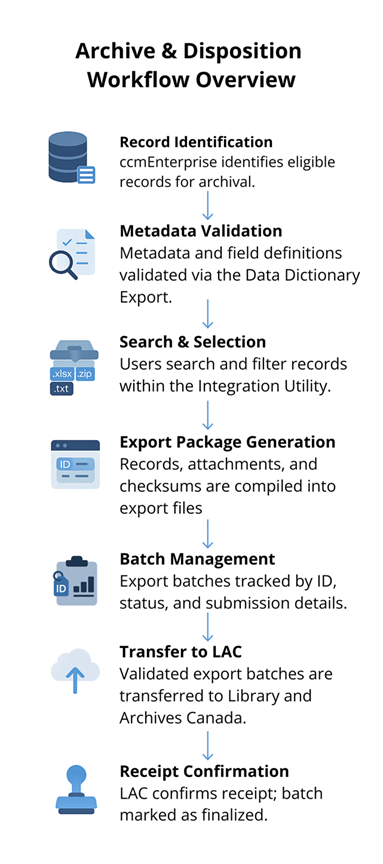
How It Works: From Record to Archive
1. Select and Prepare Records
Authorized users identify records that meet archival criteria—typically using saved searches based on retention or disposition metadata (e.g., Retention Date ≤ Today).
Once records are selected, the system:
- Validates metadata completeness using CCM Enterprise retention and disposition fields.
- Includes associated content such as documents, attachments, comments, contacts, routing history, and audit trails as part of the export process.
- Generates a Data Dictionary. This contains field definitions, types, labels, and tooltips, which are required for submissions to LAC and useful for reporting tools.
2. Generate the Export Package
The workflow assembles all selected records into a structured export package prepared for LAC submission. The WDT Integration Utility produces standardized export files along with summary and validation outputs, including checksums to verify integrity throughout the process.
3. Archive Confirmation and Audit Trail
Once the export is completed, users update the batch status in the LAC Export area so that records are clearly marked as submitted or confirmed received. All export-related activity is captured in the audit log. This includes:
- Exported record IDs
- User and timestamp information
- Batch and export details
- Validation results
- Checksum verification
These records establish a complete chain of custody that supports governance requirements and ensures transparency throughout the archival process.

Seamless Integration Across the ccmEnterprise Ecosystem
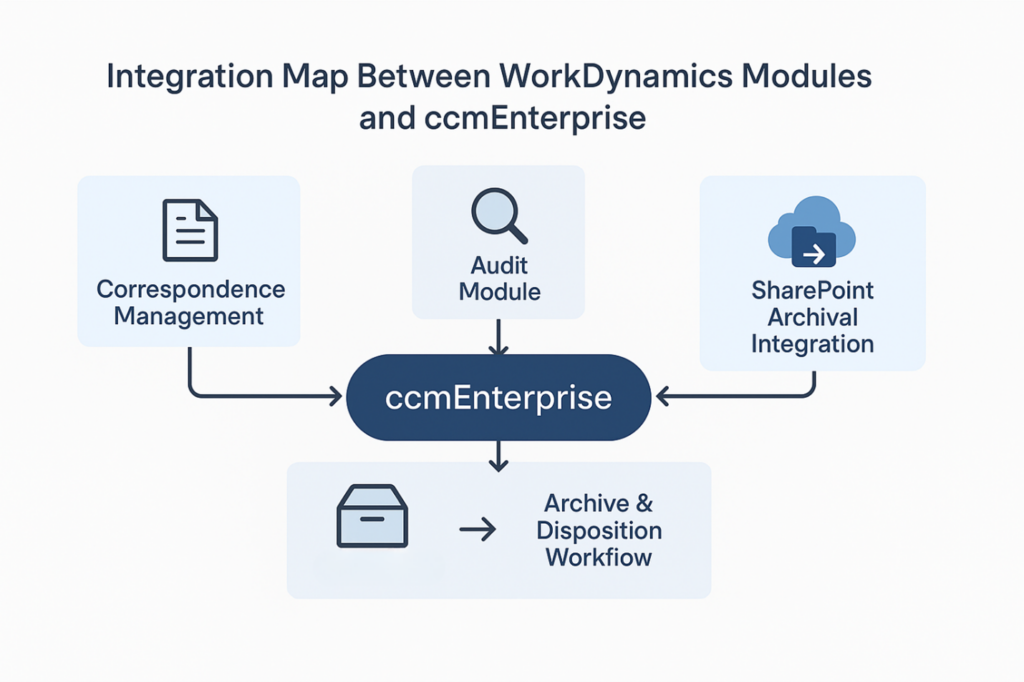
WorkDynamics automation and records management capabilities are designed to operate cohesively within the ccmEnterprise environment, already used by over 20 federal and provincial partners including Transport Canada, DND, ECCC, PSPC, and RCMP. The Archive and Disposition module works alongside existing CCM components, including:
- Correspondence workflows
- Record creation and classification tools
- Search and retrieval features
- Audit logging and reporting functions
Together, these modules support a unified compliance and governance framework that ensures archival processes remain connected to broader organizational workflows.
Key Features Supporting LAC Compliance
| Feature | Description | LAC Relevance |
| Automated Data Dictionary Generation | Exports metadata directly from ccmEnterprise Designer views | Ensures metadata completeness per LAC schema |
| Record Validation Engine | Confirms selected records and related items are ready for export | Reduces the risk of incomplete archival packages |
| Batch Export Utility | Processes large volumes of records efficiently | Aligns with departmental archival cycles and LAC transfer workflows |
| Immutable Audit Logs | Captures export actions, timestamps, and user activity | Provides a verifiable chain of custody for compliance reviews |
| Permission Controls | Restricts archival actions to authorized roles | Ensures proper governance and security |
| Disposition Reports | Provides an overview of exported items and batch details | Simplifies internal review and sign-off |
These capabilities operate within a secure enterprise environment that includes role-based access controls, audited user activity, and encryption measures implemented across the ccmEnterprise platform.
Automation and Governance: A Unified Approach
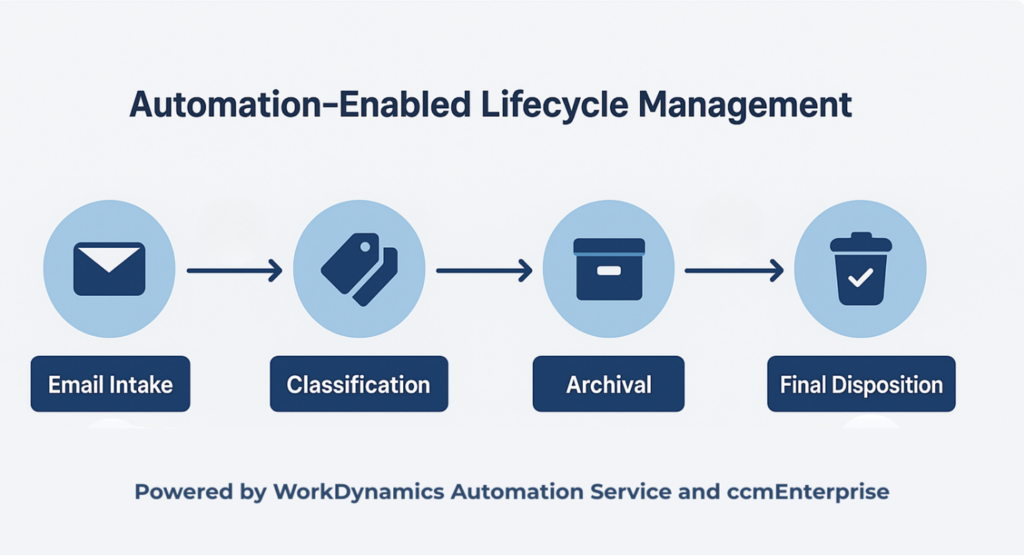
The Archive & Disposition Workflow operates within a broader automation-enabled lifecycle that spans intake, classification, archival preparation, and final disposition. Together, WorkDynamics Automation Service and ccmEnterprise support the flow illustrated above by enabling:
- Automated email intake and record creation, ensuring correspondence enters the system with consistent metadata extracted at the source.
- AI-assisted classification and routing, applying business rules that populate retention and disposition fields aligned with departmental and LAC requirements.
- Structured archival preparation, where eligible records are exported, validated, and packaged through the Archive and Disposition Workflow.
- Flexible archival storage, where classified records and their attachments can be stored in ccmAttachments, SharePoint, or OpenText (Gcdocs), depending on departmental architecture and security needs.
- Configurable disposition workflows, allowing departments to align internal schedules with LAC retention codes.
Combined, these tools reduce compliance risk while freeing information officers from repetitive administrative work.
Benefits at a Glance
✅ Simplified Compliance
Automates key steps of the archival workflow, including preparing LAC-ready export packages with structured data, attachments, and validation outputs.
✅ Proven Accountability
Comprehensive audit logs record export actions, user activity, timestamps, and batch updates, supporting internal reviews and compliance audits.
✅ Centralized Control
All archival preparation, export management, and batch status updates occur directly within ccmEnterprise, providing a unified governance environment.
✅ Scalable for All Departments
Designed to handle high-volume archival cycles, including the ability to export thousands of records in a single batch.
✅ Reduced Administrative Overhead
Minimizes manual effort by automating metadata extraction, package generation, attachment processing, and integrity verification steps.
The Bigger Picture: Compliance as a Strategic Advantage
In an era of digital transformation, compliance is not just about meeting requirements—it is about building institutional resilience.
By automating intake, classification, archival preparation, and disposition management, WorkDynamics enables departments to:
- Reduce time spent preparing for audits
- Minimize data retention and disposition risks
- Accelerate digital transformation initiatives
- Improve transparency and public trust
Departments can now focus their resources on strategic governance and service delivery, instead of manual compliance work.
Conclusion
WorkDynamics’ Archive & Disposition Workflow brings compliance with Library and Archives Canada (LAC) requirements within reach of every government department.
By combining automation, transparency, and audit-ready reporting, the solution transforms LAC compliance from a manual burden into a streamlined, verifiable process.
Whether for annual disposition cycles or large-scale archival exports, WorkDynamics empowers Records and Information Management professionals to achieve compliance confidently, without complexity.
Ready to Simplify Your LAC Compliance?
Contact WorkDynamics to learn how our Archive & Disposition Workflow can integrate seamlessly into your existing records management framework.