



What Is a FOIA Request? A Complete Guide to the Freedom of Information Act
You ever wonder how journalists somehow get their hands on internal government emails… the kind that end up splashed across front pages or buried halfway through a late-night investigative podcast episode?
Most of the time, it isn’t some cloak-and-dagger whistleblower. It’s paperwork. A request form. A law that’s been around since the 1960s quietly doing its job.
That law is the Freedom of Information Act, usually shortened to FOIA. And a FOIA request—well, that’s simply the mechanism people use to ask the federal government to hand over records that would otherwise stay tucked away in filing systems, servers, or the digital equivalent of dusty cabinets.
Sounds simple enough, right? In theory, yes. In practice… it’s a bit messier.
What Is a FOIA Request?
Let’s strip the jargon out of it.
A FOIA request is a formal request submitted to a U.S. federal agency asking for access to government records. Emails. Reports. Policy memos. Contracts. Data. Sometimes even photographs or audio recordings.
Pretty much anything the government has created or collected while doing its work.
The legal backbone here is the Freedom of Information Act of 1966, signed into law by President Lyndon B. Johnson—reluctantly, if the historical accounts are to be believed. The idea was straightforward: in a democracy, citizens shouldn’t have to guess what their government is doing behind closed doors.
So FOIA created a right. A public right.
Anyone can submit a request.
Journalists do it all the time. Advocacy groups use it to uncover regulatory decisions. Researchers dig through agency records. Occasionally regular citizens file requests out of curiosity—or frustration—or just because they want answers.
You don’t need to be an American citizen, either. That surprises people.
Technically speaking, any person can file a FOIA request, regardless of nationality. Students, reporters, watchdog organizations, lawyers, everyday taxpayers—it’s all fair game.
And the types of records requested? They run the gamut:
- Internal agency emails
- Government contracts and spending reports
- Environmental impact studies
- Inspection records
- Policy drafts and memos
- Data collected through federal programs
Sometimes the results are mundane. A spreadsheet nobody outside a department cares about.
Other times—well, sometimes a single FOIA request ends up reshaping a national conversation. It happens more often than you’d think.
Now, here’s a small wrinkle people don’t always realize.
FOIA applies specifically to federal agencies—think departments like Homeland Security, the EPA, the Department of Defense, and so on. It doesn’t cover Congress, the courts, or state governments.
States have their own public records laws. Similar spirit, different rules.
California has one. Florida does too. Canada has ATIP. The UK has its own Freedom of Information Act. Different systems, same general principle: public accountability.
And accountability, as anyone who’s ever tried filing a request will tell you, can sometimes move at the speed of molasses.
But that’s a story for the next section.
Why FOIA Requests Matter for Government Transparency
Funny thing about transparency—it sounds noble, almost poetic, until you realize it usually starts with someone asking an awkward question.
“Can we see those records?”
That’s basically FOIA in a nutshell.
Because governments, like big organizations everywhere, don’t naturally fling their internal documents out into the open. Not maliciously, necessarily. Sometimes it’s just bureaucracy doing what bureaucracy does—filing things away, protecting processes, avoiding headaches. But without some kind of pressure valve, the public would be stuck squinting at press releases and hoping for the best.
FOIA is that pressure valve.
It gives ordinary people a tool—clunky at times, admittedly—to peek behind the curtain of federal agencies and understand what decisions are being made, how money is spent, and whether policies are actually doing what officials claim they do.
Journalists rely on it constantly.
If you’ve ever read an investigative story where reporters reference “documents obtained through a FOIA request,” that’s exactly what happened. Someone filled out the request, waited (sometimes months… sometimes longer), and eventually received records the public otherwise wouldn’t have seen.
Some of the biggest government stories in the past few decades started that way.
Environmental groups have uncovered pollution data that agencies hadn’t publicized. Civil liberties organizations have revealed surveillance policies buried in internal memos. Even local community advocates—people who simply want to know why a federal project suddenly changed direction—use FOIA to get clarity.
And honestly, sometimes the documents themselves aren’t explosive at all. Just illuminating.
A policy draft showing how decisions were debated.
Emails revealing how agencies coordinate responses.
Budget spreadsheets explaining where funding actually goes.
Small details. But they add up.
Transparency tends to work like sunlight through a cracked door. At first it’s just a thin beam. Then more leaks through, and suddenly the room looks a lot different than it did before.
That’s the real point of FOIA—not to embarrass government officials or stir up controversy, though that occasionally happens. The goal is simpler.
Accountability.
When agencies know their decisions may eventually become public, they tend to document things more carefully. They think harder about policy choices. They anticipate scrutiny. And while that doesn’t magically eliminate mistakes (we’re all human, after all), it does nudge institutions toward greater openness.
Of course—and here’s where reality intrudes—FOIA requests don’t always produce immediate answers. Agencies can delay responses. Records can be partially redacted. Sometimes requests are denied altogether.
Still. The mechanism exists.
And in a democracy, having the right to ask for information—even when the process is slow, frustrating, or slightly maddening—is a pretty powerful thing.
How to File a FOIA Request
Alright—so you’ve decided you want information from the government. Maybe you’re researching a policy change. Maybe you’re a journalist chasing a lead. Or maybe something just doesn’t quite add up and you’d like to see the documents for yourself.
Good news: filing a FOIA request isn’t particularly complicated. It’s not like applying for a mortgage or assembling IKEA furniture with half the instructions missing. Still, there are a few steps involved, and getting them right can save you weeks—sometimes months—of back-and-forth.
Let’s walk through it.
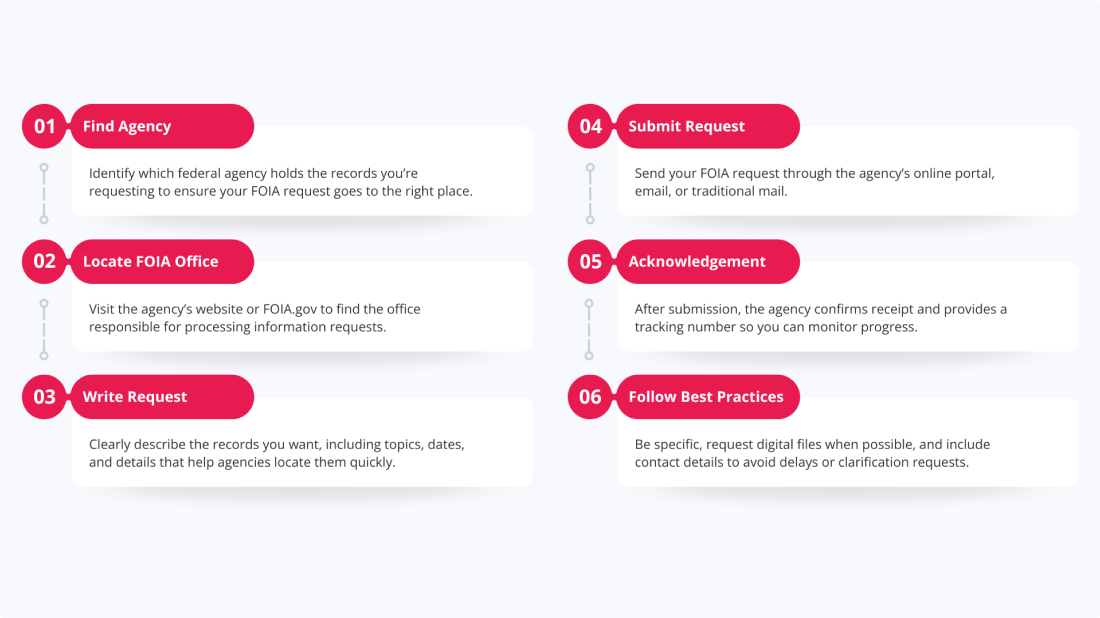
Identify the Correct Agency
This part trips people up more often than you’d think.
The federal government is enormous. Departments. Sub-agencies. Offices inside other offices. If you send a request to the wrong place, it’s a bit like mailing a letter to “The United States Government” and hoping someone sorts it out.
Sometimes they will. Sometimes they won’t.
So the first step in how to file a FOIA request is figuring out which agency actually holds the records you want. If you’re looking for environmental inspection data, the Environmental Protection Agency might be the place. Military contracting documents? Possibly the Department of Defense.
A little detective work beforehand helps—agency websites, press releases, even old news articles can point you in the right direction.
Find the Agency’s FOIA Office
Every federal agency has a FOIA office responsible for handling these requests. Think of it as the intake desk for information requests.
Most agencies now publish FOIA instructions on their websites. Many even use centralized submission portals—FOIA.gov, for example, acts as a hub where you can locate the correct office and submit requests electronically.
Some agencies still accept requests by email or traditional mail. Yes, actual envelopes. It feels a bit retro, but it works.
Write the Request
Here’s where clarity matters.
Your request doesn’t need legal jargon or fancy formatting. In fact, simple is better. Just clearly describe the records you’re seeking.
Something like:
“I am requesting copies of emails and internal communications related to [topic] between January 1, 2023 and March 31, 2023.”
That’s enough to get the process started.
The key is specificity. If the request is too vague—say, “all documents about climate policy”—the agency may push back or ask for clarification. And that, inevitably, slows everything down.
Submit the Request
Once written, you can submit the request through whatever method the agency allows:
Online FOIA portals
Email
Standard postal mail
Online portals are becoming the norm. They’re faster, easier to track, and usually generate an automatic confirmation number.
Which brings us to the next step.
Wait for Acknowledgement
After submission, the agency will typically send an acknowledgement notice confirming that your request has been received.
This notice usually includes a tracking number—important, because it lets you check the status later.
Federal law requires agencies to respond within 20 business days, though in reality the timeline can stretch longer depending on how complex the request is or how busy the agency happens to be.
Welcome to bureaucracy. It moves… deliberately.
A Few Practical Tips
Now, if you talk to people who file FOIA requests regularly—reporters, researchers, watchdog groups—you’ll hear the same advice repeated again and again.
First: be specific. The more clearly you describe what you want, the easier it is for agencies to locate the records.
Second: request electronic records whenever possible. PDFs, spreadsheets, emails—digital files move faster and are easier for agencies to provide.
And finally, include your contact information. Seems obvious, but you’d be surprised how often requests arrive without it. If the FOIA officer has a question about your request, they’ll need a way to reach you.
Otherwise the process stalls. And nobody wants that.
It’s not glamorous, filing a FOIA request. But done right, it can open doors that were previously closed—sometimes quietly, sometimes dramatically.
How to Write a FOIA Request
Here’s the part that tends to intimidate people a little. Writing the request.
Folks imagine it needs to sound like a legal brief—something drafted by a team of attorneys wearing expensive suits and speaking exclusively in footnotes. It doesn’t. Not even close.
In reality, how to write a FOIA request comes down to being clear, direct, and just specific enough that the agency knows what you’re looking for.
That’s it.
You’re basically writing a polite note that says, “Hi, I’d like to see these records.” The trick is making sure the request is detailed enough to be searchable without accidentally asking for the entire contents of a government archive.
Because trust me—if you accidentally request “all documents related to transportation policy,” someone somewhere will sigh very deeply before sending you a clarification email.
Let’s break down what actually matters.
Start With a Clear Subject Line
FOIA officers handle a mountain of requests. Some agencies process thousands every year. So the clearer your subject line is, the better.
Something simple works perfectly fine.
“FOIA Request – Communications Regarding Highway Safety Grant Program”
Straightforward. No mystery. No dramatic flair required.
The subject line just tells the agency what your request is about so it lands in the right workflow.
Describe the Records You Want
This is the heart of the request.
The more precisely you can describe the records, the easier it is for the agency to locate them. Think in terms of topics, people involved, and types of documents.
Emails between specific offices.
Reports created during a certain investigation.
Contracts issued under a specific program.
Clarity helps everyone.
And honestly—this is where a little curiosity goes a long way. If you already know the name of a project or policy, include it. If you’ve seen references to a particular memo, mention that too.
Even small clues help narrow the search.
Specify a Timeframe
Timeframes matter more than most people realize.
Without a date range, agencies may have to search through years—sometimes decades—of archived records. That slows things down dramatically.
A request that says:
“Records related to environmental inspection findings from January 2022 through June 2023”
…is much easier to process than a request covering “all inspection records ever.”
So when you can, anchor your request to a specific window of time.
State Your Preferred Format
These days most records live in digital form anyway, but it never hurts to be explicit.
You can request that documents be provided electronically—PDF files, spreadsheets, email exports, whatever format the agency normally uses.
Electronic records tend to move through the system faster. Less scanning, fewer printing steps, fewer opportunities for paperwork to vanish into a bureaucratic black hole.
Mention a Fee Waiver (If Relevant)
Sometimes agencies charge small processing fees—especially if a request involves large volumes of records.
Journalists, researchers, or nonprofit organizations often request a fee waiver, arguing that the information will be used for public benefit rather than commercial purposes.
It doesn’t always apply. But if it does, it’s worth mentioning in the request.
A Simple FOIA Request Template
Here’s what a short FOIA request might look like in practice. Nothing fancy—just clear communication.
Subject: FOIA Request – Internal Communications Regarding Renewable Energy Grant Program
To Whom It May Concern,
Under the Freedom of Information Act, I am requesting access to records related to the Renewable Energy Grant Program administered by your agency. Specifically, I am seeking internal communications, including emails and memoranda, discussing program funding decisions between January 1, 2023 and March 31, 2023.
I request that the records be provided in electronic format if available.
If any portion of this request is denied, please cite the specific FOIA exemption that justifies the withholding.
Please feel free to contact me if clarification is needed. My contact information is included below.
Thank you for your time and assistance.
Sincerely,
[Name]
[Email Address]
[Phone Number]
That’s really all there is to it.
Not perfect. Not overly polished. Just clear, specific, and respectful.
And sometimes—surprisingly often, actually—that’s enough to get the ball rolling.
How Long Does a FOIA Request Take?
Here’s the question almost everyone asks at some point—usually after hitting the submit button and staring at their inbox a little too optimistically.
How long does a FOIA request take?
Well. Officially? Not that long.
In the real world? It depends. Sometimes quite a bit.
Let’s start with the rulebook before we talk about reality.
The Official Timeline
Under the Freedom of Information Act, federal agencies are required to respond within 20 business days after receiving a request.
Twenty working days. Roughly four weeks.
That response doesn’t necessarily mean you’ll receive the records right away. What it typically means is that the agency must acknowledge the request and tell you what happens next—whether the records will be released, withheld, partially redacted, or whether more time is needed.
In theory, it’s meant to keep the system moving.
In practice… things get a little more complicated.
Possible Extensions
FOIA law allows agencies to extend the timeline in certain situations.
For example:
If the request involves a large number of records
If records must be retrieved from multiple locations
If the agency needs to consult with another department or agency
When that happens, agencies can add extra time to process the request. They’re supposed to notify you when they do.
And to be fair, sometimes the delays are understandable. Government archives aren’t always neat and tidy, and some records require careful review before they can be released.
Still, extensions are pretty common.
The Real-World Timeline
Here’s the part most people learn after filing their first request.
Even though the law says 20 business days, many FOIA requests take significantly longer—sometimes several months. Occasionally longer than that.
It’s not unusual.
Some agencies process straightforward requests quickly, especially if the records are easy to locate. But more complex requests can move through multiple review stages, legal checks, and coordination between offices.
So patience helps. A lot.
What Actually Affects FOIA Processing Time?
A handful of factors tend to influence how quickly a request moves through the system.
First, record complexity. If the documents are straightforward—say, a single report or a small set of emails—they’re easier to review and release.
Then there’s volume. Requests that involve thousands of pages obviously take longer than requests for a handful of documents.
Sometimes agencies must consult with other agencies before releasing records, particularly if the documents contain information shared across departments. That coordination can slow things down.
And then there’s the one factor nobody likes but everyone deals with.
Backlogs.
Some federal agencies receive enormous numbers of FOIA requests every year. Tens of thousands in some cases. When requests pile up faster than they can be processed, the queue grows.
Which means your request might sit in line for a while.
Not forever—but long enough that most people eventually stop refreshing their inbox every ten minutes.
It’s frustrating, sure. But FOIA still works. Slowly, occasionally unevenly, yet it works—and that’s what keeps the system moving forward.
How to Check the Status of a FOIA Request
At some point—usually a few weeks after submitting a request—you’ll probably find yourself wondering:
Did they even receive it?
It’s a fair question. FOIA requests can take time, and the silence between submission and response sometimes feels… well, a bit like sending a message into the void.
The good news is that most agencies provide ways to track or follow up on your request. You don’t have to sit around guessing.
Here are the most common ways people check the status of a FOIA request.
Online FOIA Portals
Many federal agencies now use online FOIA portals to manage requests. If you submitted your request through one of these systems, you’ll usually receive login credentials or a tracking link.
Inside the portal, you can typically see updates like:
Whether the request has been received
Whether it’s currently under review
If records are being processed or released
Any requests for clarification
It’s a bit like tracking a package shipment—except the “delivery window” might be several months instead of two days.
Still, it’s the easiest way to monitor progress.
Email Communication
Some agencies handle FOIA requests primarily through email rather than a portal.
In that case, the best way to check status is simply to reply to the original confirmation email or send a follow-up message to the agency’s FOIA office.
Keep it short and polite. Something along the lines of:
“I’m writing to check the status of FOIA request number [tracking number], submitted on [date]. Please let me know if there are any updates.”
No need to get confrontational. A friendly nudge usually works better.
Agency Tracking Numbers
When you submit a request, agencies typically assign a tracking number. Think of it as your request’s ID card.
That number is important.
You’ll use it anytime you contact the agency, check a portal, or request updates. Without it, staff may have trouble locating your request in the system.
So—pro tip—save the confirmation email somewhere safe. People lose those more often than they admit.
FOIA Public Liaison
Here’s something not everyone knows.
Each federal agency has a FOIA Public Liaison, whose job is to help resolve issues between requesters and the agency. If your request seems stuck, delayed, or confusing, the liaison can sometimes step in and provide guidance.
They won’t magically speed things up—but they can explain what’s happening and help smooth out misunderstandings.
Tips for Following Up
Now, a quick word about follow-ups.
It’s perfectly acceptable to check on your request, especially if several weeks have passed with no updates. But it helps to approach it with a little patience.
A few simple guidelines make things easier:
Wait a reasonable amount of time before following up
Include your tracking number in every message
Keep communication polite and concise
Respond quickly if the agency asks for clarification
Most FOIA officers are dealing with dozens—sometimes hundreds—of active requests at any given time. A clear, respectful follow-up tends to get better results than an angry one.
And sometimes, surprisingly enough, that gentle check-in is exactly what moves a request forward.
What Are the 9 Exemptions to a FOIA Request?
Now, here’s where things get a little less straightforward.
People often assume that filing a FOIA request guarantees access to whatever records they’re asking for. Open government, right? Full transparency?
Well… mostly.
But not entirely.
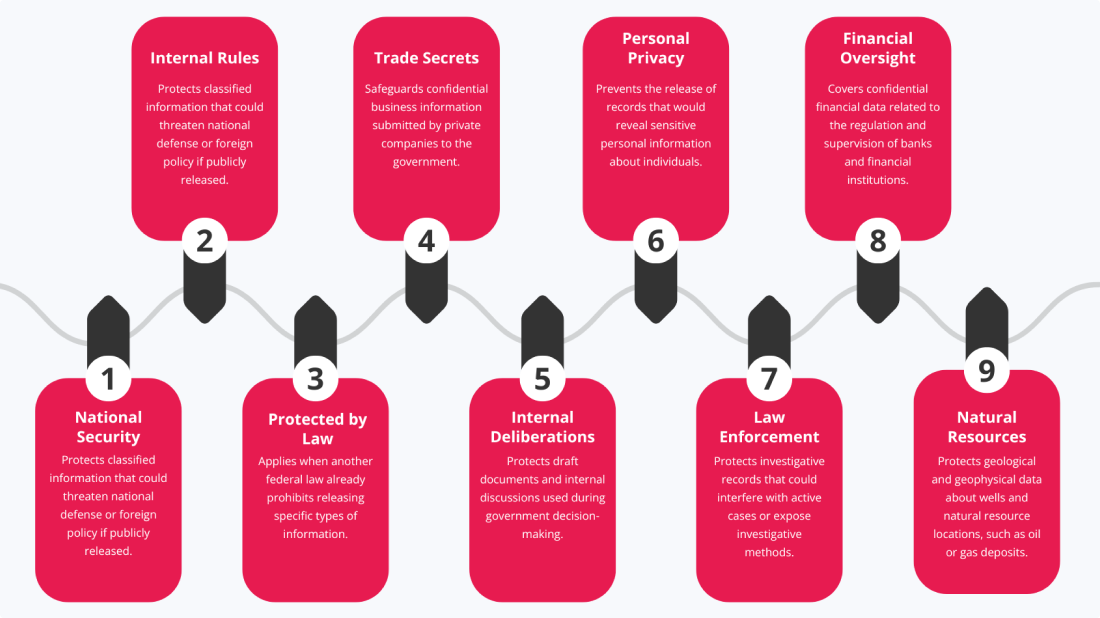
The Freedom of Information Act includes nine specific exemptions that allow agencies to withhold certain information. These exemptions exist for good reason—protecting national security, safeguarding personal privacy, or preventing sensitive business data from becoming public.
So if you’ve ever wondered what are the 9 exemptions to a FOIA request, here’s the breakdown. And yes, each one has its own quirks.
National Security
This exemption protects information that could harm national defense or foreign policy if released.
Think classified military plans, intelligence operations, or sensitive diplomatic communications.
For example, documents detailing military strategies or intelligence-gathering methods would almost certainly fall under this exemption. No surprise there—some secrets genuinely need to stay secret.
Internal Agency Rules and Practices
This one covers internal government procedures that aren’t meant for public distribution.
Imagine employee manuals, internal security procedures, or operational guidelines used by agency staff. Releasing certain internal processes could potentially expose vulnerabilities or make systems easier to manipulate.
For instance, a detailed handbook explaining how a federal agency handles cybersecurity responses might be withheld under this exemption.
Information Exempt Under Other Laws
Sometimes FOIA itself isn’t the final authority.
If another federal law specifically prohibits releasing certain types of information, that law takes priority. In other words, FOIA won’t override existing confidentiality protections written into other statutes.
Tax return data is a classic example. Federal law strictly protects taxpayer information, so those records can’t be released through FOIA requests.
Trade Secrets and Confidential Business Information
This exemption protects sensitive information provided to the government by private companies.
Businesses often submit proprietary data—financial reports, product designs, manufacturing methods—when dealing with federal agencies. If that information were publicly released, competitors could gain an unfair advantage.
Picture a pharmaceutical company submitting confidential research data to the FDA during a drug approval process. That data would almost certainly be protected.
Inter-Agency or Intra-Agency Communications
Government officials need space to discuss policy ideas freely. This exemption protects internal deliberations that occur before decisions are finalized.
Draft reports, internal recommendations, or policy discussions often fall under this category.
For example, early drafts of a proposed environmental regulation might be withheld while agencies debate the final wording.
The reasoning is simple: policymakers should be able to speak candidly without worrying that every preliminary idea will immediately become public.
Personal Privacy
Not all government records involve public policy. Some contain private details about individuals.
This exemption protects personal information that could invade someone’s privacy if disclosed—things like medical records, home addresses, Social Security numbers, or personnel files.
For instance, if a FOIA request sought detailed employee records for federal workers, identifying information would almost certainly be redacted.
Law Enforcement Records
This one covers records related to criminal investigations or law enforcement activities.
Releasing certain documents too early could interfere with investigations, reveal confidential informants, or expose investigative techniques.
Let’s say someone files a FOIA request for documents related to an ongoing FBI investigation. Those records might be withheld until the investigation concludes—or longer, depending on sensitivity.
Financial Institution Supervision
Federal agencies oversee banks and financial institutions, often reviewing confidential financial data during audits or regulatory inspections.
This exemption protects that information to prevent financial instability or misuse of sensitive economic data.
For example, records from a federal audit of a major bank’s financial health would likely remain confidential under this exemption.
Geological and Geophysical Information
This final exemption is oddly specific—and yet surprisingly important.
It protects geological data related to wells and natural resources, particularly information submitted by companies exploring oil, gas, or mineral deposits.
If the government holds detailed maps showing the precise location of underground oil reserves, releasing those records could create massive competitive advantages in the energy industry.
So that information stays protected.
FOIA Request Software for Government Agencies
Let’s be honest for a moment. On paper, the FOIA process sounds tidy—requests come in, staff review them, records are located, responses go out. Nice and orderly.
But inside most agencies? It’s rarely that neat.
Requests arrive from everywhere. Email inboxes, online portals, even old-fashioned mail. Some are short and precise. Others… less so. Deadlines start ticking immediately, documents need to be reviewed carefully, exemptions applied correctly, and every step must be tracked for legal compliance.
That’s a lot to manage.
Which is why many government organizations have started turning to FOIA request software to keep the whole process from turning into administrative chaos.
Because once an agency starts receiving hundreds—or thousands—of requests each year, spreadsheets and shared inboxes simply don’t cut it anymore.
Automating Request Intake
The first challenge agencies face is simply collecting and organizing incoming requests.
FOIA software helps by automatically capturing requests submitted through email, web forms, or public portals. Instead of manually logging each request into a system, the platform records the request details immediately—date received, requester information, subject matter, and any attachments.
No lost emails. No forgotten requests buried in inbox folders.
Just a clean intake process.
Tracking Deadlines
Remember that 20-business-day response timeline we talked about earlier? Agencies have to track those deadlines carefully.
Software platforms make this easier by automatically calculating due dates and sending reminders when deadlines approach. Staff can see which requests are pending, which ones are in progress, and which responses need to go out soon.
Without that kind of tracking, it’s surprisingly easy for deadlines to slip by unnoticed.
Routing Requests to the Right Teams
FOIA requests rarely belong to just one person.
Some require input from legal teams. Others need records from multiple departments. Sometimes a request touches several agencies at once.
Modern FOIA systems allow agencies to route requests automatically to the correct office or staff member based on keywords, departments, or subject categories.
Which saves a lot of internal email chains that start with “Who should handle this?”
Generating Responses
Responding to requests often involves preparing formal letters, applying exemptions, and assembling the requested records.
FOIA software helps agencies generate response templates, manage redactions, and organize documents before they’re released to requesters.
It streamlines the process while still allowing staff to review everything carefully before sending it out.
Maintaining Compliance
And finally—perhaps the most important piece—software helps agencies maintain compliance with FOIA regulations.
Every action can be logged. Every request tracked. Every response documented.
That audit trail matters, especially if a requester files an appeal or if the agency needs to demonstrate that it followed the proper procedures.
For agencies handling large volumes of requests, these systems aren’t just convenient—they’re essential.
If you’re curious about how dedicated tools can simplify FOIA workflows, you can learn more about FOIA Request Software and how it helps agencies manage requests efficiently while staying compliant with transparency laws.
Final Thoughts
If you step back for a moment and look at the bigger picture, FOIA is doing something quietly remarkable.
It gives ordinary people the legal right to ask questions—real questions—about how their government operates. Not through rumors, not through filtered summaries, but through actual records. Emails. Reports. Data. Decisions made behind conference room doors that eventually shape public policy.
That’s why FOIA remains one of the cornerstones of government transparency in the United States. It’s imperfect, sure. Requests can take time. Documents may arrive heavily redacted. Occasionally the process feels a little like navigating a maze designed by committee.
Still, the door is there. And anyone can knock.
At the same time, the volume of requests federal agencies receive today is far larger than when the law first passed in 1966. Processing requests efficiently—without missing deadlines or mishandling sensitive records—has become a significant operational challenge for many government departments.
Which is exactly why efficient FOIA request management matters.
Clear workflows. Proper tracking. Organized document review. These aren’t just administrative details; they’re the infrastructure that allows transparency laws to function in practice rather than just in theory.
For agencies looking to modernize the process, specialized platforms can make a real difference. Tools designed specifically for request intake, tracking, routing, and compliance help teams manage growing workloads while still meeting legal requirements.