


What Is CPRA Compliance? A Complete Guide for Businesses
There’s a moment—usually sometime between yet another “we’ve updated our privacy policy” email and the third cookie consent banner you mindlessly click through—when you start to wonder… who’s actually in control of all this data?
Not you. Not really.
And that’s kind of the point.
Somewhere in the background, quietly but very deliberately, regulations like the California Privacy Rights Act (CPRA) have been tightening the screws on how businesses collect, use, and—let’s be honest—sometimes exploit personal data. It’s not just legal jargon anymore. It’s becoming part of everyday business survival. And if you’re running a company, or even advising one, CPRA compliance isn’t optional. It’s table stakes.
Now, I’ll admit—“compliance” is one of those words that makes people’s eyes glaze over. It sounds bureaucratic. Dry. Maybe even a bit painful. But CPRA? It’s different. It’s more… assertive. It hands actual power back to consumers, and in doing so, forces organizations to rethink how they handle information at a pretty fundamental level.
So what is CPRA compliance, really? And why does it feel like everyone’s scrambling to figure it out at the same time?
That’s what we’re getting into here. Not just the definition—but the implications, the headaches, and yes, the smarter ways to deal with it before it becomes a full-blown operational mess.
What Is CPRA Compliance?
So—what is CPRA compliance, really?
In plain English, it means following the rules laid out in the California Privacy Rights Act (CPRA)—a law designed to rein in how businesses handle personal data. Not just collect it, but justify it, protect it, and, when asked, give it back or delete it. Simple in theory. Less so in practice.
Now, CPRA didn’t replace the earlier CCPA—it builds on it. Expands it. Tightens the bolts. If CCPA was the warning shot, CPRA is the “we’re serious now” phase.
Who does it apply to? Not just companies physically sitting in California. If you do business with California residents, you’re likely on the hook. Especially if you hit certain thresholds—say, over $25 million in annual revenue, or handling data from 100,000+ consumers. Numbers like that.
But beneath all the legal language, the goal is pretty human: give people more control over their own data. What’s collected. Why it’s used. And whether they want it gone.
Key Differences Between CPRA and CCPA
Here’s where things start to shift—from “pretty serious” to actually enforceable.
On paper, CPRA looks like an extension of CCPA. In reality? It’s more like a tightening of the screws. Same foundation, yes—but with sharper edges and fewer loopholes to wiggle through.
First big change: the creation of the California Privacy Protection Agency (CPPA). This is new. Under CCPA, enforcement was mostly handled by the Attorney General’s office. With CPRA, there’s now a dedicated watchdog—an agency whose sole job is to oversee and enforce privacy laws. Which, honestly, changes the tone entirely. It’s like going from occasional speed checks to a permanent traffic camera.
Then there’s the expanded definition of sensitive personal information. Not all data is treated equally anymore. Things like precise location, financial details, health data—these fall into a more protected category. Businesses can’t just collect and use this casually; there are tighter rules around it, and consumers can limit how it’s used.
And speaking of consumers, their rights? Stronger. More direct. People can now correct inaccurate data, restrict how sensitive data is used, and push back on data sharing in ways that weren’t as clearly defined before.
Put it all together, and CPRA feels less forgiving. Less vague. More… deliberate.
And that’s why it’s tougher—not just to understand, but to ignore.
Core CPRA Compliance Requirements
This is where things stop being abstract and start getting… operational. Real processes. Real systems. And, if we’re being honest, a fair bit of scrambling in some organizations.
Because CPRA compliance isn’t one single task—it’s a web of responsibilities that all have to work together (and keep working, day after day).
Consumer Rights
Let’s start with the heart of it—the consumer.
CPRA gives individuals a surprising amount of say over their data. More than most companies were used to, frankly.
They can:
- Know what data you’ve collected and how you’re using it
- Delete it (yes, even if it’s inconvenient for you)
- Correct inaccurate information—because bad data can cause real problems
- Opt out of having their data sold or shared
- And—this one’s new-ish—limit how sensitive personal information is used
It’s a bit like giving customers the keys to a room that used to be locked. And now they can walk in anytime and ask questions.
Data Governance & Accountability
Behind the scenes, this is where companies either sink or swim.
You need to actually know your data. Not vaguely. Not “it’s somewhere in the CRM.” Precisely.
That means:
- Building a data inventory—what you collect, where it lives
- Practicing purpose limitation (don’t collect data “just in case”)
- Applying data minimization—only keep what you genuinely need
Sounds reasonable. In reality? It can feel like untangling a decade’s worth of digital spaghetti.
Transparency Requirements
No more hiding behind vague language.
Businesses are expected to clearly explain:
- What data they collect
- Why they collect it
- Who they share it with
And this shows up in privacy notices—those pages nobody used to read. Now they actually matter. They have to be clear, accessible, and… honest. Imagine that.
Vendor & Third-Party Management
Here’s the tricky part—your responsibility doesn’t stop with your own systems.
If you’re sharing data with vendors, partners, or service providers, CPRA expects:
- Proper contracts that define how data is handled
- Clear restrictions on what those third parties can do with it
So if a vendor mishandles data? That can come back to you. Not ideal.
Security & Risk Management
And finally—security. The part everyone knows is important but sometimes underestimates.
CPRA doesn’t spell out exact technical controls, but it does expect “reasonable security measures.” Which is a bit vague, sure—but also intentional. What’s reasonable depends on your business, your data, your risk.
And if there’s a breach?
Well… liability becomes very real, very quickly. Fines, lawsuits, reputational damage—it’s not just a compliance issue at that point. It’s a business crisis.
Why CPRA Compliance Is Important for Businesses
Let’s be honest—most businesses don’t wake up excited about compliance. It’s not exactly a thrill ride. But CPRA? Ignoring it isn’t just risky… it’s expensive, short-sighted, and—if you squint a little—kind of bad for business long-term.
Here’s why it actually matters.
Legal penalties and fines
First, the obvious one: legal penalties.
CPRA violations can lead to fines that stack up quickly—especially if you’re dealing with large volumes of consumer data. And unlike earlier regulations, there’s less room for “oops, we’ll fix it later.” Enforcement is stricter now. Faster, too. One mistake might slide. A pattern? That’s where things get ugly.
Reputational risk
Then there’s reputational risk.
This one’s harder to quantify—but arguably more damaging.
Data misuse stories spread fast. One headline, one breach, one poorly handled consumer request… and suddenly your brand is the example everyone points to in meetings like, “let’s not be them.” Trust, once cracked, doesn’t snap back easily. It lingers. Customers remember.
Consumer trust and competitive advantage
On the flip side—done right—CPRA compliance can actually become a competitive advantage.
Strange, I know. But consumers are paying attention now. They care about how their data is handled. Companies that are transparent, responsive, and respectful of privacy? They stand out. Quietly, but meaningfully. It builds trust. And trust—well, that’s currency.
Alignment with global regulations
And then there’s the bigger picture.
CPRA isn’t happening in isolation. It lines up with global privacy trends—think GDPR in Europe, and similar laws popping up elsewhere. So if your business operates across regions (or plans to), getting CPRA right puts you ahead of the curve. Or at least… not scrambling to catch up later.
What Is the Best CPRA Compliance Solution?
There isn’t a single “perfect” tool that magically solves everything (wouldn’t that be nice?). But there are platforms that make compliance manageable—almost… sane.
The trick is knowing what to look for.
What to Look for in a CPRA Compliance Solution
At a minimum—no, actually, at a functional baseline—your solution should handle a few core things.
First, centralized data management.
If your data is scattered across five systems, three cloud apps, and someone’s forgotten spreadsheet… you’ve already got a problem. A good solution pulls that visibility together. One place. Or close to it.
Then there’s workflow automation.
Because manually handling every consumer request? That’s a fast track to burnout. Automation helps route, assign, and track requests without constant human babysitting.
You’ll also need solid audit trails and reporting.
Not glamorous, but crucial. When regulators—or auditors—come knocking, you need proof. Who did what. When. Why.
Integration matters too. A lot.
Your solution should plug into existing systems without causing chaos. CRM, document repositories, email platforms—if it doesn’t connect, it complicates.
And of course, role-based access and security controls.
Not everyone should see everything. That’s just common sense, but also compliance.
Finally—scalability.
Because what works for 1,000 records won’t hold up at 100,000. Or a million. Systems need to grow with you, not break under pressure.
Why Workflow & Case Management Platforms Matter
Here’s where things get a bit more specific.
CPRA compliance isn’t just about storing data—it’s about managing requests, actions, and accountability over time. And that’s exactly what workflow and case management platforms are built for.
Think about a typical data subject request. Someone asks to see or delete their data. That request needs to be:
- Logged
- Assigned
- Reviewed
- Completed
- Documented
And all of that needs to happen in a structured, traceable way.
A proper platform handles this end-to-end. No dropped tasks. No “who was supposed to do that?” moments.
It also ensures accountability. Every action is recorded. Every step leaves a footprint. Which, again—not exciting, but incredibly valuable when you need to prove compliance.
So while there are plenty of tools out there claiming to “support privacy,” the ones that truly work tend to have one thing in common:
They treat compliance like a process. Not a checkbox.
And that—more than anything—is what CPRA really demands.
How ccmEnterprise Supports CPRA Compliance
At a practical level, ccmEnterprise is built around managing records, workflows, and processes—and that happens to line up pretty closely with what CPRA demands.
For starters, it enables centralized tracking of records, requests, and workflows. So instead of chasing down information across systems, teams can manage compliance-related activities in one place. Or at least, one coordinated environment—which is often good enough.
Then there’s the ability to route and manage tasks across teams.
A data request doesn’t just sit with one person—it might involve legal, IT, operations. ccmEnterprise allows those tasks to move between people and departments in a structured way, without relying on endless email chains or “did you see this?” follow-ups.
It also brings strong search, reporting, and audit capabilities into the mix. Which matters more than you think. When you need to demonstrate compliance—whether for an audit or an internal review—you’re not scrambling. The records are there. The history is there. The trail exists.
On the integration side, the platform supports APIs for connecting with external systems—pulling in data, pushing updates out, aligning with existing tools rather than replacing everything outright. That flexibility is… important. Most organizations aren’t starting from scratch.
And of course, role-based access and configurable workflows help enforce governance policies. Who can see what, who can act on what—it’s all defined, not left to chance.
Steps to Achieve CPRA Compliance
Alright—this is where theory meets reality.
Because knowing what CPRA requires is one thing… actually getting there is another. And no, it’s not a one-week project. More like a series of steps—some straightforward, others a bit messy, depending on how your data is currently organized (or… not organized).
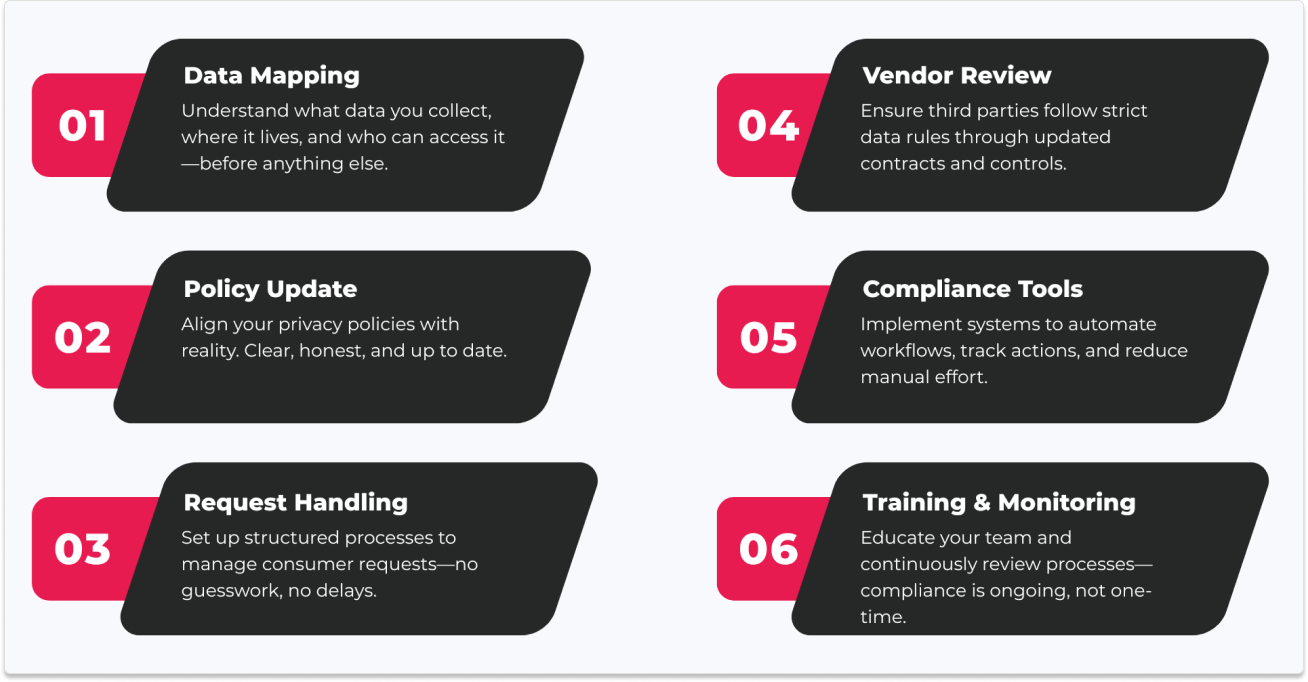
Step 1: Conduct data inventory and mapping
Start here. Always here.
You can’t protect—or manage—what you don’t fully understand. So this step is about figuring out:
- What data you collect
- Where it lives
- Who has access to it
Sounds simple. It rarely is. Most organizations discover data in places they forgot even existed.
Step 2: Update privacy policies
Once you know your data, you need to explain it. Clearly.
Your privacy policy should reflect reality, not what you think is happening. That means updating disclosures around data collection, usage, and sharing. No vague wording. No legal fog.
Step 3: Implement processes for consumer requests
This is where things get operational.
You need a defined way to handle requests—access, deletion, correction, all of it. Who receives them? Who acts on them? What’s the timeline?
Without a process, requests fall through the cracks. And that’s… not great.
Step 4: Review vendor contracts
Your vendors matter. More than most teams realize.
Any third party handling personal data should have clear contractual obligations—what they can do, what they can’t, and how they protect that data. If those contracts are outdated, it’s time for a refresh.
Step 5: Deploy a compliance solution
At some point, manual effort hits a wall.
This is where a proper solution—workflow, tracking, automation—comes in. Not just to “check the box,” but to make the whole process sustainable. Otherwise, compliance becomes a constant scramble.
Step 6: Train staff and monitor continuously
And finally—people.
Even the best system fails if no one knows how to use it. Training matters. Awareness matters. And monitoring? That’s ongoing. CPRA compliance isn’t a one-and-done situation—it evolves, just like the data landscape itself.
Final Thoughts: Staying Ahead of CPRA Without the Chaos
So here we are.
CPRA isn’t just another compliance checkbox you tick once and forget about—it’s broader, stricter, and, frankly, not going anywhere. If anything, it’s a sign of where things are headed. More oversight. More accountability. Less room for “we’ll deal with it later.”
And that’s really the takeaway, I think: waiting is the worst strategy.
Businesses that treat CPRA as a reactive exercise—something to scramble for when audits loom or complaints surface—usually end up overwhelmed. Systems break down. Requests pile up. People get frustrated. It’s not pretty.
On the flip side, organizations that take a proactive approach—mapping their data, building proper processes, investing in the right tools—tend to handle compliance with far less chaos. Not perfectly, sure. But smoothly enough that it becomes part of normal operations rather than a recurring fire drill.
Because let’s be real—CPRA is complex. There’s no way around that.
But the right solution? It doesn’t eliminate the complexity—it absorbs it. It structures it. Makes it manageable.
And that’s the difference between struggling with compliance… and actually staying ahead of it.